
Carotid Total Plaque Area for effective ASCVD MANAGEMENT.
CTPA is a quantitative carotid ultrasound method that measures the cumulative burden of atherosclerotic plaque. For clinicians, it offers a direct window into arterial disease; for patients, it makes vascular age visible and actionable.
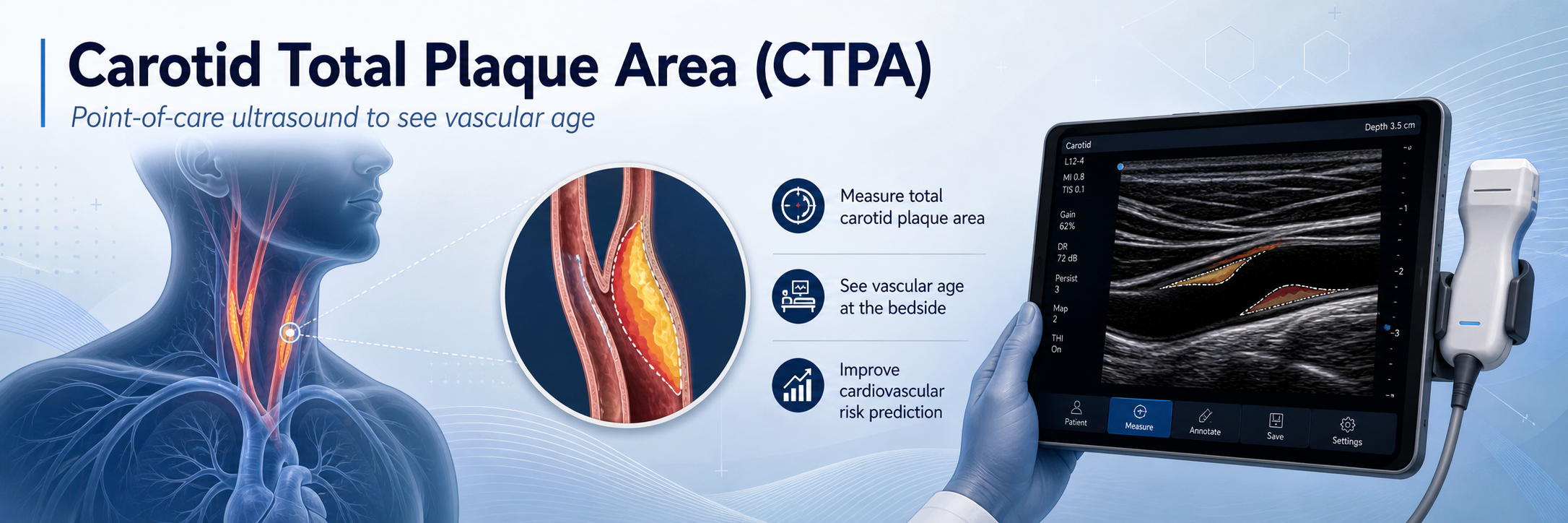
Beyond risk factors alone.
Non-invasive and repeatable.
A visible bridge from image to action.
REACT Study 2026: Silent Atherosclerosis Begins Earlier Than Expected
Presented at the ESC Congress 2026 and published in the NEJM, the REACT study (16,808 adults) strongly reinforces the clinical value of peripheral vascular ultrasound (cTPA): in approx. 85% of cases, arterial disease manifests first in the carotid arteries.
Participants (aged 18–70) without known cardiovascular disease.
had imaging-detectable silent subclinical atherosclerosis.
already affected among 18–29 year-olds (8.7% ♂ / 6.7% ♀).
Isolated coronary calcification without peripheral plaque was rare.
Clinical Takeaway: «Look at the carotid arteries first»
The REACT findings shift attention from conventional risk calculators alone toward direct, radiation-free, and sensitive detection of established subclinical disease in the carotid arteries.
Because atherosclerosis in younger adults begins predominantly in peripheral arteries and isolated coronary artery calcification is rare, the study establishes carotid ultrasound (cTPA) as the primary, high-yield entry point at the point of care.
NEJM 2026 Excerpt (Bundgaard et al.)
«Subclinical atherosclerosis was present in 57.1% of participants. In younger adults, atherosclerosis was predominantly peripheral and confined to a single vascular bed; plaque volume increased exponentially with age. Isolated coronary artery calcification was rare across all age groups (≤ 9.3% in men and ≤ 5.0% in women).»

Fig.: REACT 2026 – Multi-arterial imaging across carotid, femoral, and coronary vascular beds (NEJM / ESC 2026).
Early Peripheral Manifestation
Atherosclerosis starts early and focally in peripheral arterial beds before expanding into multi-territory disease over decades.
Sex-Specific Dynamics
Earlier rise in prevalence among men; women exhibit a later, particularly steep acceleration in plaque volume during midlife.
Implications for cTPA & POCUS
Validating the carotid artery as the primary entry point supports the core cTPA rationale: early detection and quantification directly at the bedside.
Background
Traditional cardiovascular risk estimation relies on age, blood pressure, lipids, diabetes, and smoking. CTPA adds something fundamentally different: a direct measurement of the arterial disease that those variables are trying to predict.
What CTPA measures
Carotid Total Plaque Area quantifies the summed longitudinal area of plaques detected in the extracranial carotid arteries. Rather than focusing on vessel wall thickness (=»injury») alone, it captures the actual burden of focal atherosclerosis and therefore aligns more closely with clinically relevant arterial disease.
Why vascular age matters
Chronological age and arterial age are often not the same. By visualising accumulated plaque burden, CTPA translates long-term exposure to metabolic, haemodynamic, inflammatory, and behavioural risk into a finding that is immediately understandable at the bedside.
Scientific evidence
Research on carotid plaque imaging consistently shows that plaque presence and plaque burden provide stronger prognostic information than carotid intima–media thickness alone and add incremental value to conventional risk models.
“You are as old as your arteries” becomes clinically meaningful when arterial ageing is measurable, visible, and reproducible.
Carotid plaque burden is associated with myocardial infarction, stroke, and broader ASCVD outcomes beyond standard risk factors.
CTPA can move patients out of misleading intermediate categories by revealing whether subclinical atherosclerosis is already present in clinically relevant amounts.
A quantified plaque image often communicates risk more effectively than percentages alone and can improve preventive discussions.
Clinical use
CTPA is especially relevant when risk-factor counting leaves uncertainty. In preventive practice, the method is most useful when it changes the intensity, timing, or credibility of intervention.
Identify uncertainty
Borderline or intermediate-risk profiles, discordant biomarkers, strong family history, or unexpectedly healthy patients with multiple risk factors.
Scan at the point of care
Use carotid ultrasound to detect and quantify plaque burden in a way that can be integrated into ambulatory workflow.
Translate into action
Intensify prevention, improve adherence, or avoid over-treatment by aligning therapy with demonstrable arterial disease.
Follow over time
Repeat imaging can support monitoring of progression, stability, or response to lifestyle and pharmacologic strategies.
Future Directions
Early scientific work from VARIFO suggests that CTPA may not only predict ASCVD events, but could also reflect a broader vulnerability to future morbidity.
This hypothesis fits the concept that carotid plaque burden represents cumulative biological ageing and systemic vascular injury rather than an isolated cardiovascular phenomenon. If confirmed in larger prospective studies, CTPA could evolve from a tool for cardiovascular prevention into a more general marker of disease incidence and long-term health risk.
Future significance
The future of prevention is likely to combine classical epidemiology with direct imaging of disease. CTPA fits that evolution because it is quantitative, visual, bedside-capable, and understandable for both clinicians and patients.
From score-based to disease-based prevention
Risk models remain necessary, but they are probabilistic abstractions. CTPA helps anchor decisions in demonstrable disease burden, which may support more personalised prevention strategies and a more credible rationale for treatment intensity.
Beyond ASCVD alone
Because carotid plaque reflects cumulative vascular injury, CTPA may also function as an integrative marker of broader chronic disease vulnerability. This gives the method relevance not only for cardiology, but also for internal medicine, general practice, and preventive health policy.
Why this matters for IG‑USIM
For clinicians committed to ultrasound in internal medicine, CTPA is more than another vascular metric. It exemplifies how ultrasound can expand from diagnosis toward prevention, risk communication, and longitudinal management.
CTPA fits the POCUS mindset: real-time information, direct clinical integration, minimal burden for the patient.
It offers a focused and teachable ultrasound application with immediate preventive implications.
The method connects internal medicine, cardiology, vascular medicine, and public-health thinking around measurable arterial ageing.
CTPA may become part of a broader prevention toolkit that integrates imaging, biomarkers, and longitudinal patient engagement.
Disclosure
This website presents educational and scientific information on Carotid Total Plaque Area (CTPA), vascular age, and preventive cardiovascular imaging. It is intended for professional information and interdisciplinary exchange.
For further scientific information, please visit VARIFO.
Contact
Dr. med. Michel Romanens
Spitalstr. 9
4600 Olten
michel.romanens@hin.ch
Further reading & References
Bundgaard H, García-Lunar I, Kofoed KF, et al.; REACT Investigators. Prevalence of Silent Atherosclerosis across Adult Life. New England Journal of Medicine, August 29, 2026. DOI: 10.1056/NEJMoa2609059.
A relevant publication is available here: Point-of-care ultrasound: Treat the arteries, not the risk factors.
The article highlights the shift from abstract risk-factor assessment toward direct visualization of arterial disease and therefore aligns closely with the core CTPA concept: prevention guided by measurable plaque burden and vascular age. It provides an overview of 20 years of research by the Vascular Risk Foundation and adds clinically meaningful tools for cardiovascular risk assessment.